This content contains affiliate links — if you sign up through them, we may earn a commission. This does not affect our reviews. How we make money
The Labouchere Strategy is among the most popular roulette systems (source: kingcasino.com)
Every true roulette lover should know the basic betting strategies. Among the most well-known, besides Martingale, d’Alembert, and Fibonacci, is Labouchere. Its principle lies in creating sums from a numerical sequence and gradually crossing them out depending on whether the player’s last bet was winning or losing. This system is known in two versions, so players can choose the one they prefer the most.
This roulette system was invented in the 19th century by Sir Henry Labouchere, who was a Member of the British House of Commons for over thirty years, also served as Minister of Trade and Minister of Colonies, was a member of the government several times, and in 1859 entered the House of Lords as a baron. He was also a passionate roulette player whose betting system spread among other enthusiasts, where it is often known as the cross-out strategy.
Principle of the Labouchere Strategy
Like other roulette systems, this one uses even bets. Players bet on black or red, low/high, or even/odd numbers. The payout ratio of these bets is also even, thus 1:1. The essence of this strategy is that the player creates a numerical sequence with any number of numbers. However, it is important that their number is even. During the game, the player then adds or crosses out more numbers.
How the Labouchere System Works
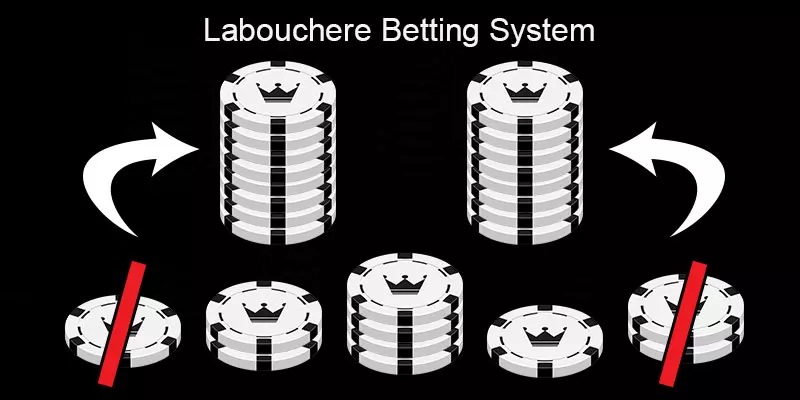
Once the player chooses a numerical sequence (e.g., 1, 2, 3, 4, 5, 6, but it can also be 3, 3, 3, 3, or 1, 1, 2, 2, 3, 3, etc.), they bet the number of units according to the sum of the first and last number in the sequence (in the first case, 7 units). If they manage to win the bet, they add this number to the numerical sequence and continue with the same principle as long as they keep winning (now they would bet 1 + 7 = 8 units). Crossing out numbers occurs when their bet loses. After a losing bet, the player crosses out the first and last number from the numerical sequence, which are then replaced by adjacent numbers. If they manage to lose right in the first round with a numerical sequence from 1 to 6, they cross out one and six. The first and last numbers will newly be two and five. In the next round, they bet the number of units according to their sum (in this numerical sequence again 7). Every time they win their bet, the numerical sequence is extended. In case of a loss, it is shortened.
Advantages of the Labouchere System
Besides not having to worry about what bet to place in the next round, this system brings other advantages. If its user has at least a bit of luck in the game, they will gradually add higher winnings and subtract smaller losses. Conversely, if they encounter a series of losses, they quickly cross out the numerical sequence and will not lose more than the prepared capital. In both cases, however, they can leave the numerical sequence at any time and create a new one.
Reverse Labouchere
This betting strategy can also work in reverse. The player crosses out bets that they have won and adds the sum of the first and last number to the numerical sequence when they lose. With a numerical sequence of 1 – 6, they bet 7 units, and if they lose right in the first round, they add seven as the result of the sum after six. If they win in the first round, they cross out one and six and again bet seven units in the next round, as the result of the sum 2 + 5. The disadvantage of this system, however, is a much higher risk of loss.
Expansion of the Labouchere System
Players have modified and improved this betting system according to their needs, resulting in Labouchere on two dozens or on both colors, which are supposed to provide players with an even greater chance of winning.
Labouchere on two colors: for each color, the player creates their own numerical sequence, and then in each round bets on both colors. Only if one bet is exactly half of the other, then the lower bet can be omitted and only half of the higher one is bet. Whatever color falls, the result will be the same, but if 0 falls, the player loses less (except in French roulette, where bets are frozen until the next round).
Labouchere on two dozens: This strategy works on the same principle as betting according to the Labouchere system on two colors. In this case, however, the player always bets on the two dozens that did not fall in the last spin. In case of a win (or a loss in the reverse system), the sum is recorded at the end of the numerical sequence twice.
Once the player completely crosses out one numerical sequence, there is nothing left but to create a new one. Ideally, the same numerical sequence as for the second color.
Best Online Casinos
Frequently Asked Questions
What is Labouchere?
It is a roulette system where players place bets according to a created numerical sequence. They always bet the number of units corresponding to the sum of the first and last number in the sequence.
What do you bet on with the Labouchere system?
This strategy was built on betting even bets, i.e., on color, low/high, and even/odd numbers with an even payout ratio of 1:1. However, players have adjusted it, and it is possible to place bets on both colors or two dozens on the same principle.
What is reverse Labouchere?
In the standard Labouchere, the number of units according to the sum of the first and last number in the sequence is recorded at the end of the sequence after each win, and the first and last number in the sequence is crossed out after a loss. The reverse Labouchere works exactly the opposite way, so the sums are recorded at the end of the sequence when losing, and the numbers are crossed out when winning.